
Sabin Vaccine Institute’s Investigational Marburg Vaccine Delivered to Ethiopia for Outbreak Response
Sabin Vaccine Institute’s investigational cAd3-Marburg Vaccine
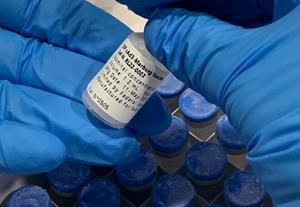
A vial of Sabin Vaccine Institute’s investigational cAd3-Marburg Vaccine
WASHINGTON, Dec. 04, 2025 (GLOBE NEWSWIRE) — The Sabin Vaccine Institute (Sabin) has sent more than 640 doses of its investigational cAd3-Marburg Vaccine to Ethiopia to support the country’s response to its first-ever outbreak of Marburg virus disease. Marburg is a highly contagious hemorrhagic fever disease and can have a high case fatality rate of up to 88%. There are currently no licensed vaccines or treatments for Marburg.
Soon after Marburg was confirmed as the virus causing a hemorrhagic fever outbreak in Ethiopia’s southern region, the Ethiopia Ministry of Health engaged Sabin and the U.S. government to request access to Sabin’s investigational cAd3-Marburg Vaccine. The U.S. government approved this request. The Biomedical Advanced Research and Development Authority (BARDA), part of U.S. Department of Health and Human Services’ Administration for Strategic Preparedness and Response (ASPR), funds the development and manufacture of Sabin’s investigational vaccine candidate.
Sabin and the Ethiopia Ministry of Health have entered into a clinical trial agreement under which Sabin is providing BARDA-funded investigational cAd3-Marburg Vaccine doses for a two-cohort Phase 2, rapid response, open-label, randomized trial to assess safety, efficacy, and immunogenicity. Under this approved protocol, Cohort A is limited to high-risk health care and front-line workers or individuals who have had direct contact with infected persons within 21 days, the incubation period for Marburg virus disease. All other health care and front-line workers and contacts will be randomized in Cohort B, some receiving vaccine on Day 1 and others on Day 22 of the trial.
“The Ethiopian Ministry of Health reached out to Sabin early in the outbreak, and we have been working in partnership to support Minister of Health Dr. Mekdes Daba and her team,” says Sabin Chief Executive Officer Amy Finan. “We’ve built on our previous outbreak response experience to quickly assist our Ethiopian colleagues as requested.”
In addition to coordinating directly with the Minister of Health and the Armauer Hansen Research Institute (AHRI), Sabin is also working closely with manufacturing partner ReiThera, clinical research organization IQVIA and the Coalition for Epidemic Preparedness Innovations (CEPI) – the same organizations that came together to support Rwanda’s response to their 2024 outbreak. With authorization from ASPR, Sabin provided cAd3-Marburg Vaccine to the Rwanda Biomedical Center for use in a Phase 2 clinical trial.
Ethiopia’s Ministry of Health has confirmed 13 Marburg infections, including eight deaths, in their most recent update. Another three deaths are suspected but not confirmed. Officials continue to express concern about the outbreak’s proximity to fragile health settings in nearby Kenya and South Sudan.
In addition to Sabin’s single-dose cAd3-Marburg Vaccine being used in a Phase 2 outbreak clinical trial in Rwanda, the vaccine is also in Phase 2 clinical trials in the U.S., Uganda and Kenya. More than 2000 trial participants have received the vaccine and no significant safety concerns have been reported. Results from Phase 1 clinical trials and nonclinical studies indicate that the vaccine is safe and elicits rapid, robust immune responses.
The Sabin cAd3-Marburg Vaccine doses have been supported in whole or in part with federal funds from the U.S. Department of Health and Human Services; Administration for Strategic Preparedness and Response; Biomedical Advanced Research and Development Authority (BARDA), under contract numbers 75A50119C00055 and 75A50123C00010.
Once rare, Marburg virus disease outbreaks have surged in Africa in recent years, with incidents reported in 2023 in Tanzania and Equatorial Guinea, in 2024 in Rwanda and in 2025 in Tanzania. Marburg is transmitted from fruit bats to humans, spreading from person to person through contact with infected bodily fluids.
About the Sabin Vaccine Institute
The Sabin Vaccine Institute is a leading advocate for expanding vaccine access and uptake globally, advancing vaccine research and development, and amplifying vaccine knowledge and innovation. Unlocking the potential of vaccines through partnership, Sabin has built a robust ecosystem of funders, innovators, implementers, practitioners, policy makers and public stakeholders to advance its vision of a future free from preventable diseases. As a non-profit with three decades of experience, Sabin is committed to finding solutions that last and extending the full benefits of vaccines to all people, regardless of who they are or where they live. At Sabin, we believe in the power of vaccines to change the world. For more information, visit www.sabin.org and follow us on X, @SabinVaccine.
About the cAd3 Platform
In August 2019, Sabin announced exclusive agreements with GSK for Sabin to advance the development of the prophylactic candidate vaccines against the deadly Zaire ebolavirus, Sudan virus, and Marburg virus. The three candidate vaccines were initially developed collaboratively by the U.S. National Institutes of Health and Okairos, which was acquired by GSK in 2013. The candidate vaccines, based on GSK’s proprietary cAd3 (Chimpanzee Adenovirus Type 3) platform, were further developed by GSK, including the Phase 2 development for the Zaire ebolavirus vaccine. Under the agreements between GSK and Sabin, Sabin exclusively licensed the technology for all three candidate vaccines and acquired certain patent rights specific to these vaccines. Sabin is developing the cAd3-Marburg Vaccine and cAd3-Sudan Vaccine, both are in Phase 2 clinical trials in the US and Africa.
Media Contact:
Monika Guttman
Media Relations Specialist
Sabin Vaccine Institute
+1 (202) 662-1841
[email protected]
A photo accompanying this announcement is available at https://www.globenewswire.com/NewsRoom/AttachmentNg/c29e0887-de65-45d0-9d2f-4365a8bc78ea
GlobeNewswire Distribution ID 9597202
Sabin Vaccine Institute’s investigational cAd3-Marburg Vaccine
A vial of Sabin Vaccine Institute’s investigational cAd3-Marburg Vaccine
WASHINGTON, Dec. 04, 2025 (GLOBE NEWSWIRE) — The Sabin Vaccine Institute (Sabin) has sent more than 640 doses of its investigational cAd3-Marburg Vaccine to Ethiopia to support the country’s response to its first-ever outbreak of Marburg virus disease. Marburg is a highly contagious hemorrhagic fever disease and can have a high case fatality rate of up to 88%. There are currently no licensed vaccines or treatments for Marburg.
Soon after Marburg was confirmed as the virus causing a hemorrhagic fever outbreak in Ethiopia’s southern region, the Ethiopia Ministry of Health engaged Sabin and the U.S. government to request access to Sabin’s investigational cAd3-Marburg Vaccine. The U.S. government approved this request. The Biomedical Advanced Research and Development Authority (BARDA), part of U.S. Department of Health and Human Services’ Administration for Strategic Preparedness and Response (ASPR), funds the development and manufacture of Sabin’s investigational vaccine candidate.
Sabin and the Ethiopia Ministry of Health have entered into a clinical trial agreement under which Sabin is providing BARDA-funded investigational cAd3-Marburg Vaccine doses for a two-cohort Phase 2, rapid response, open-label, randomized trial to assess safety, efficacy, and immunogenicity. Under this approved protocol, Cohort A is limited to high-risk health care and front-line workers or individuals who have had direct contact with infected persons within 21 days, the incubation period for Marburg virus disease. All other health care and front-line workers and contacts will be randomized in Cohort B, some receiving vaccine on Day 1 and others on Day 22 of the trial.
“The Ethiopian Ministry of Health reached out to Sabin early in the outbreak, and we have been working in partnership to support Minister of Health Dr. Mekdes Daba and her team,” says Sabin Chief Executive Officer Amy Finan. “We’ve built on our previous outbreak response experience to quickly assist our Ethiopian colleagues as requested.”
In addition to coordinating directly with the Minister of Health and the Armauer Hansen Research Institute (AHRI), Sabin is also working closely with manufacturing partner ReiThera, clinical research organization IQVIA and the Coalition for Epidemic Preparedness Innovations (CEPI) – the same organizations that came together to support Rwanda’s response to their 2024 outbreak. With authorization from ASPR, Sabin provided cAd3-Marburg Vaccine to the Rwanda Biomedical Center for use in a Phase 2 clinical trial.
Ethiopia’s Ministry of Health has confirmed 13 Marburg infections, including eight deaths, in their most recent update. Another three deaths are suspected but not confirmed. Officials continue to express concern about the outbreak’s proximity to fragile health settings in nearby Kenya and South Sudan.
In addition to Sabin’s single-dose cAd3-Marburg Vaccine being used in a Phase 2 outbreak clinical trial in Rwanda, the vaccine is also in Phase 2 clinical trials in the U.S., Uganda and Kenya. More than 2000 trial participants have received the vaccine and no significant safety concerns have been reported. Results from Phase 1 clinical trials and nonclinical studies indicate that the vaccine is safe and elicits rapid, robust immune responses.
The Sabin cAd3-Marburg Vaccine doses have been supported in whole or in part with federal funds from the U.S. Department of Health and Human Services; Administration for Strategic Preparedness and Response; Biomedical Advanced Research and Development Authority (BARDA), under contract numbers 75A50119C00055 and 75A50123C00010.
Once rare, Marburg virus disease outbreaks have surged in Africa in recent years, with incidents reported in 2023 in Tanzania and Equatorial Guinea, in 2024 in Rwanda and in 2025 in Tanzania. Marburg is transmitted from fruit bats to humans, spreading from person to person through contact with infected bodily fluids.
About the Sabin Vaccine Institute
The Sabin Vaccine Institute is a leading advocate for expanding vaccine access and uptake globally, advancing vaccine research and development, and amplifying vaccine knowledge and innovation. Unlocking the potential of vaccines through partnership, Sabin has built a robust ecosystem of funders, innovators, implementers, practitioners, policy makers and public stakeholders to advance its vision of a future free from preventable diseases. As a non-profit with three decades of experience, Sabin is committed to finding solutions that last and extending the full benefits of vaccines to all people, regardless of who they are or where they live. At Sabin, we believe in the power of vaccines to change the world. For more information, visit www.sabin.org and follow us on X, @SabinVaccine.
About the cAd3 Platform
In August 2019, Sabin announced exclusive agreements with GSK for Sabin to advance the development of the prophylactic candidate vaccines against the deadly Zaire ebolavirus, Sudan virus, and Marburg virus. The three candidate vaccines were initially developed collaboratively by the U.S. National Institutes of Health and Okairos, which was acquired by GSK in 2013. The candidate vaccines, based on GSK’s proprietary cAd3 (Chimpanzee Adenovirus Type 3) platform, were further developed by GSK, including the Phase 2 development for the Zaire ebolavirus vaccine. Under the agreements between GSK and Sabin, Sabin exclusively licensed the technology for all three candidate vaccines and acquired certain patent rights specific to these vaccines. Sabin is developing the cAd3-Marburg Vaccine and cAd3-Sudan Vaccine, both are in Phase 2 clinical trials in the US and Africa.
Media Contact:
Monika Guttman
Media Relations Specialist
Sabin Vaccine Institute
+1 (202) 662-1841
[email protected]
A photo accompanying this announcement is available at https://www.globenewswire.com/NewsRoom/AttachmentNg/c29e0887-de65-45d0-9d2f-4365a8bc78ea
GlobeNewswire Distribution ID 9597202